Showing posts with label 2D Animation. Show all posts

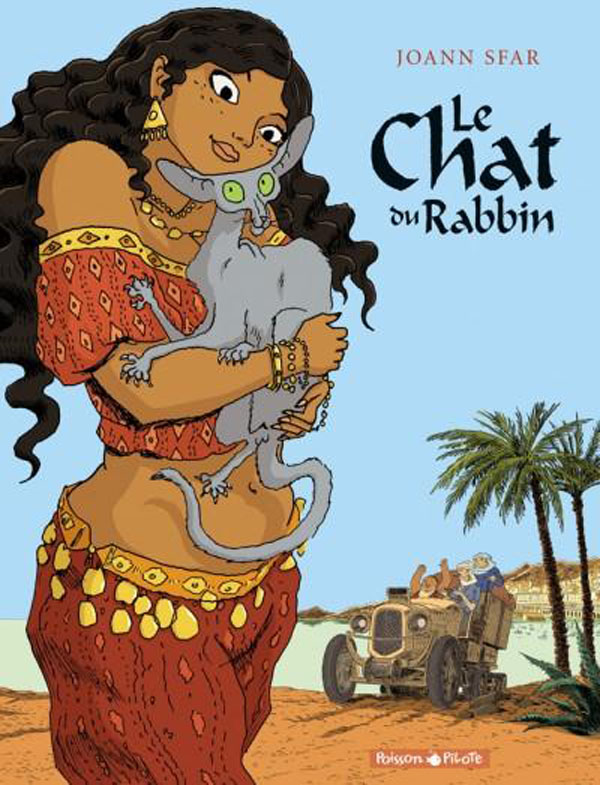
THE RABBI'S CAT - LE CHAT DU RABBIN - animated feature film


Another hand-drawn feature length animated film from France ! LE CHAT DU RABBIN .  I'll say it again:  thank goodness the French did not get the silly memo (or they ripped it up)  from Hollywood that decreed "2D is dead".

Trailer for THE RABBI'S CAT  -


THE RABBI'S CAT - LE CHAT DU RABBIN - TRAILER from Banjo Studio on Vimeo.


There are several "Making of..." videos on Vimeo:


Making of Le Chat du Rabbin - Banjo - from Banjo Studio on Vimeo.

The film (directed by Joann Sfar  and Antoine Delesvaux) is adapted from the graphic novel by Joann Sfar . 
The studio Autochenille Production was launched in 2007 by Joann Sfar, Antoine Delesvaux and Clément Oubrerie with the aim to make "author-driven, challenging films to appeal to children and adults.".

The Rabbi's Cat was the company's first project. The production was made in collaboration with TF1 and France 3. It was pre-bought by Canal+ and CineCinéma and had a budget of 12.5 million euro. (17.5 million U.S. dollars)

One of the directors' sources of inspiration was American animation from the 1930s, and in particular from the Fleischer Studios, which Sfar described as characterized by multi-ethnical production crews and for portraying darker aspects of society, in cartoons such as Betty Boop and Popeye.    In order to generate more personality for the drawn characters in The Rabbi's Cat, some of the scenes were staged in a Parisian suburb loft in the summer of 2008, with props and the cast fully costumed. As the actors performed and invented their characters' personal motion habits, the design team observed closely and drew what they picked up.


More making-of videos here:

http://vimeo.com/user6584121/videos

Headless Productions

Headless Productions is a small independent animation studio founded by Adrian Garcia, Alfredo Torres and Victor Maldonado,  based in Barcelona.

Show reel:


A teaser for their latest project "I'm A Monster"

This is a piece developed to give an idea of the mood and look of the film and the characters.

Sylvain Chomet interview

Sylvain Chomet, director of Belleville Rendez-Vous and now The Illusionist. Photograph: Paul Cooper

Sylvain Chomet talks about his new film "The Illusionist" -

http://www.guardian.co.uk/film/2010/jun/10/sylvain-chomet-belleville-rendezvous-illusionist


The biggest problem [in making the film] was finding the animators. Like the music-hall acts in the film, animators had become convinced by Hollywood that their time had passed.

"A lot of animators, basically people who can draw, got scared by these wankers from Disney saying that 2D animation is dead, that it was only going to be 3D and Pixar from now on. It is just typical shit by people in ties who don't know what they are talking about. Are they saying that Aardman is dead, too, then? I mean how stupid are these people? Saying 2D is dead is like saying that a car race is the future of the Tour de France."

"We had trouble because the fantastic animators we found had got really stressed because they thought after our film there was not going to be any 2D any more. Some were driving buses or retraining. People really had been made to believe that the end had come. The truth is that animation is always mixing things up: pen and paper, stop motion, puppets, 3D. Suddenly this bizarre competition has been created. What it is, one more time, is this American reflex to kill off the competition, to say that you can only do it one way and destroy everything else that went before. The whole society is like that. They destroy what they have to build something new. They end up with no roots to draw on, nothing to compare their work with to see if it is good or not. American culture is in real danger of starving itself to death. You just have to see what Hollywood is producing to see how narrow it is getting."

A Day For Hand Drawn Animation - 2009

"A Day For Hand-Drawn Animation -2009"
(click on image to view it larger)

I posted about this last year , here:

http://hand-drawn-animation.blogspot.com/2008/11/day-for-hand-drawn-animation.html

with a follow-up post , here:


This annual "Day for Hand Drawn Animation" is sponsored by Tahsin and Lâle Özgür at Maltepe University in Istanbul .

All devotees of hand drawn animation are invited to mark the day , regardless of their geographical location. (the internet creates such a small world).

This year Tash and Lâle write:

November 18th, a Day for Hand-Drawn Animation

A universe of dreams and fantasy that opened up with
Steamboat Willie on November 18th, 1928, or even earlier, with Little Nemo in 1911. A universe wonderful for the spectator, and even more so for the artists and craftsmen.

The tradition is alive and well in 2009.

May we all celebrate, those of us who insist on keeping it alive, and those of us who never tire of watching!

-Tash & Lâle Özgür


I thought the point that Tash made last year about the distinction of "hand drawn animation" is important to repeat:

"We call it, in our quaint Oriental tongue, Çizgi Film Bayrami, which clumsily translates as "Line-Film Holiday" or something ... "Line-Film" being what we call this kind of film. English lacks a direct equivalent, and the more generic term "animation" might have even facilitated the CG takeover ("it's all animation, isn't it?")

Think of our concept of "line film" as closer to the French "dessin animé" ("animated drawing") - it's French, language of culture, so it probably has more weight in the argument. Which argument? Why, that hand drawn animation is a distinct art form, and not simply a step on the way towards something else. "
------

Recently the veteran animator/designer/director Gene Deitch made a similar point in a speech prepared for the Xiamen International Animation Festival (Oct. 30th-Nov. 3rd) in China. Gene's speech is titled "Quo Vadis Animation?" The entire text of his speech is on Cartoon Brew:


Here is the summary:

“The core of my speech is a pitch for the survival and eventual return to primary favor of “drawn animation.” (Don’t provoke me by mentioning the term “2D” in my presence!)"

Here is a video Gene made since his travel visa was not approved by the Chinese government , so he was not able to present the speech at the Xiamen International Animation Festival :

Richard Purdum - Tate Gallery Liverpool , Modern Art

Amazing animated commercial for the Tate Gallery Liverpool, by Richard Purdum. (from 1988)


The image in the video (from VHS tape) is a bit soft and the colors not as vivid as the original, but this YouTube video is the only version of this I could find online.

If you want to see what it actually looked like go to Hans Bacher's blog to see frame grabs from a good print:

Tate Gallery Liverpool , Modern Art - by Richard Purdum

Eric Goldberg talk- AAU Fall Animation Festival 2008

Each Fall the Academy of Art University Animation Department has a Fall Animation Festival. In 2008 the special guest speaker was master animator Eric Goldberg who regaled the assembled students with a recounting of his brilliant career in animation (ongoing) with film clips accompanying his many charming anecdotes about his adventures in animation.


Click on the link to view Eric's presentation.


(once you get to the "Industry on Campus" site , click on the link to "Industry on Campus: Eric Goldberg") .

I hope you enjoy watching this presentation as much as I did.

If you're an animation student at Academy of Art University (or anywhere else) and you don't yet own a copy of Eric's wonderful book "Character Animation Crash Course" then GET IT . (I mean it : go order it right now. Hop to it !)

Myths of the Animation Industry


from The Illusionist directed by Sylvain Chomet

Excellent article from the folks at Animation Mentor that should be read by all students of animation:


By Mark Garabedian


The animation industry is the business of creating myth and magic. As such, it's not surprising that a myriad of meta-myths have arisen—easy-to-believe falsehoods about the industry itself. In preparing for their future careers, the next generation of animators and artists need not be waylaid by such rumors. Below are five common myths about the world of cartoons and the realities behind them.


Myth: 2D animation is a dying art -

Nothing could be further from the truth. While 3D animation is filling theaters across the globe, 2D art endures. Internationally, films such as Sony Picture's Persepolis ,Paprika , and The Secret of Kells continue to astound audiences with engrossing, hand-drawn cinema. In Scotland director/animator Sylvain Chomet (The Triplets of Belleville) is nearing completion on his next hand-drawn animated feature , The Illusionist. In the U.S. , Walt Disney Animation is hard at work on its new 2D feature, The Princess and the Frog, while shows such as Nickelodeon's Avatar: The Last Airbender and Cartoon Network's Chowder provide bright futures for the traditional style. Beyond television, the Internet has spawned numerous opportunities for vector animation (Flash and Toonboom) 2D projects as well.

Myth: It's essential to be adept at every facet of the animation process -

To quote G.I. Joe, "Knowing is half the battle." The other half is being good at what you do. Familiarity with the entire animation process can only help you, but you are being hired for a specific position. In the words of Knowledge Adventure 3D Artist Chris Marsh, "Fanning your effort and skills out to do everything the process demands only decreases your quality of work and increases production time, and that's never good." The animation process requires the efforts of many specialized individuals. Walt Disney didn't achieve his whimsical empire by being the greatest animator ever. He did so by assembling the greatest animation team ever. Discover what you do best and strive to do it better.

Myth: You want to work for a big studio -

Certainly there's no shame in working for a large studio. Who wouldn't want to have Mickey Mouse on their business card? But smaller studios have their share of perks too. A smaller company gives a great artist more opportunity to shine. Networking becomes easier, and there's more room to expand your personal style.

Myth: You should stick with a single studio for as long as possible -

Ladders: We all have the urge to climb them, especially corporate ones. But in the animation industry, sometimes it's important to spread your artistic wings. Surely no one wants an artist who never sticks around to finish a project, but by changing studios and production companies from time to time, you make yourself better known to the animation community as a whole, networking, and becoming associated with your body of work rather than your company's. "A good stint at a company is one to three years," says Big Bad Tomato digital storyboard artist Sylvia T. Leung, "it shows you are committed enough to stay, but ambitious enough to leave."

Myth: You don't need to know how to draw-

While drawing is not necessarily a key skill in today's world of texture mapping and wire framing, it's still a valuable technique in almost every step of the animation process. Putting pencil to paper, breaking down complex objects into simple shapes, and translating them into graphite blueprints will help artists of all fields better their craft. This ability will also make you more attractive to a wider number of prospective employers. Remember, even Rodin roughly sketched his figures before casting clay.

Just as 24 drawings a second creates the illusion of motion, assumptions and opinions give the illusion of industry facts. Fortunately, the truth is usually quite optimistic and should give any budding artist hope for their creative and professional future.


An old one , but a good one : The Training of a Golden Age Animator

Looking through some notes today I found a link to a couple of old posts on other people's blogs that are worth reading for any of you animation students (and worth reading for those of us who have been around the business for a while) .

The first is an article on the ASIFA Animation Archive called "The Training of a Golden Age Animator" , which came about when the director of the ASIFA Animation Archive, Steve Worth, was asking himself the question: "What sort of education did golden age animators have? "

Steve posts some examples from the life of master animator Carlo Vinci.

The essay , "The Training of a Golden Age Animator" should be read and taken to heart by all of us who would be students of the art of animation.

The second bit of wisdom I have for you was posted by Will Finn : A Letter From Ward Kimball.   

When he was in High School the young Mr. Finn wrote to Disney animator Ward Kimball for advice about getting into the animation field. Kimball's letter, written in typical iconoclastic Kimball style, is a very sage piece of advice and despite the breezy style conveys that Kimball respected and cared for young animators or wannabe animators like Will Finn (who in fact went on to become one of our finest contemporary animators) .

Here is the reply that Ward Kimball sent to Will Finn:

Kimball letter to Finn

Good reading.

"Coyote & The Tortoise" by Fat Cat Animation

**NOTE: this film is unfortunately no longer available for download from the MyToons website as MyToons abruptly shut down recently.


Short film from Fat Cat Animation in Phoenix, Arizona. Directed by Len Simon.

Audi Animated spot - Passion Pictures

Audi spot animated at Passion Pictures, London.


A Forum for Classical Hand-Drawn Animation


Animator Chris Doyle has started a new forum for the discussion of classical hand-drawn animation:


Check it out.  Jump in and participate in the discussion. 

In one discussion related to the post down below about  "A Day for Hand-Drawn Animation" celebration in Turkey,  animator Tahsin Özgür makes a very good distinction about the place of hand-drawn animation:

"Today is Nov. 21st, three days already since the Hand Drawn Animation Day held at Maltepe University in Istanbul.

We called it,  in our quaint Oriental tongue,
 Çizgi Film Bayrami, which clumsily translates as "Line-Film Holiday" or something ... "Line-Film" being what we call this kind of film. English lacks a direct equivalent, and the more generic term "animation" might have even facilitated the CG takeover ("it's all animation, isn't it?") 

Think of our concept of "line film" as closer to the French "dessin animé" ("animated drawing") -  it's French, language of culture, so it probably has more weight in the argument. Which argument?  Why, that hand drawn animation is a distinct art form, and not simply a step on the way towards something else. "

That is a good distinction and I wish the English language had such a term as "Line-Film"  or  "le dessin anime" to denote animated drawings.

I usually try to make the distinction by using the terms "traditional animation" or "classical animation" , or "hand-drawn animation". The one term I do not care for as much , but seems ubiquitous now is "2D Animation" . Animation can be completely CG , but also be 2D (such as vector-based animation in Flash or ToonBoom) .   For better or worse the Academy of Art University has designated our department as the "2D Animation Dept." , so that's the term I have to work with for now.  (hence, I am the Online Coordinator of 2D Animation at AAU ).

But what we're really talking about here is animation that is expressed through drawing.  That's not at all to disparage CG animation or Stop Motion puppet animation, etc.   However,  the ascendancy of CG animation has unfortunately led to the widely held  perception that Tash mentions:   that hand drawn animation is "simply a step on the way towards something else" rather than being a distinct art form in and of itself. 

Milt Kahl scene -- where does it come from ?

A small mystery :

I found this Milt Kahl scene from "The Rescuer's" posted on YouTube.  My question in the title -- "where does it come from?" -- doesn't refer to the film ; I know it's from "The Rescuer's".

But as far as I can see this shot is not in the final version of the film, but it feels to me like I remember seeing it  (in color) in the original theatrical release of the film.  But this scene is NOT in the DVD release of the film.  Was it cut out for some reason or is my memory playing a trick on me and this shot was never actually in the theatrical version of the film ? 

Does anyone know when or why this scene was cut out of  "The Rescuer's"  ? 


(there's no sound in the clip posted on YouTube. What are they saying ? Anyone know ? )

Here is another very similar set up , from the work-print of the sequence included on the extras of the Frank & Ollie documentary. This scene is in the final film .


(does anyone else see the one-frame camera shooting mistake on Medusa's hand at the very end of the scene ? That was fixed before the scene went to final color.)

A Day For Hand Drawn Animation

*UPDATE:  Jeff Treves dropped by and left this comment below:

 "The festival was great! We are trying to make it even bigger for the next year. Here are some photos for those who are interested. " --
A Day For Hand-Drawn Animation Festival Photos

-----

I enjoyed seeing the photos.  Jeff and some others may enjoy seeing this photo of Tahsin Özgür taken at Sheridan College in 1982 .  (not that long ago , right , Tash ?) 

(click the photo to see it larger)


--------

"As in previous years we at Anadolu University and Maltepe University are observing Nov. 18th, anniversary of the release of Steamboat Willie, as a day to celebrate traditional hand-drawn animation.  

This year our special theme will be Frank and Ollie, since Ollie Johnston passed away since our last celebration. Please join us in our celebration."


-Tahsin ("Tash") and Lale Özgür


My friend Tashin Özgür has reminded me that he and his wife Lale have started a tradition at Anadolu University and Maltepe University to observe November 18th (anniversary of the release of Steamboat Willie) as a day to specifically celebrate traditional hand-drawn animation. An excellent idea and one that I heartily endorse . Hopefully this will become an international movement among all who cherish the art of hand-drawn animation.

If you can't sit down to re-read "The Illusion of Life" this week, at least put in the DVD of the movie "Frank & Ollie" .
(but if you haven't read "The Illusion of Life" lately, make a point to pick it up again. I guarantee you that you'll find something new and exciting that you missed before ... at least that's how I have found it each time I've returned to this foundational tome).

(click on the image to see it larger)

Ollie Johnston - Glen Keane : On Teamwork , Collaborating

If you haven't heard this little snippet of Glen Keane's remembrance of Ollie Johnston at the Ollie Tribute , then you should really drop everything you're doing and listen to this now: 

Glen on Ollie 

And take a look at this too: 


Inspiration - Fred Moore's dwarf scenes

Pedro Daniel Garcia has kindly posted a reel of most of Fred Moore's animation of the Seven Dwarfs from Disney's "Snow White and the Seven Dwarfs".


Sometimes you will read things about Fred Moore that are written in a slightly condescending tone, like "oh, yeah, poor old Freddy, he was good for his time ... a little rough around the edges,  not sophisticated enough to "keep up" with the better animators at Disney "   etc.    


As though Moore's animation was kind of simple but charming work that doesn't really hold up compared to what came later .
But really now ... look at this reel of animation and tell me if you've seen much contemporary animation that comes anywhere close to the level of work that Fred Moore is doing here ? (this was done in 1936 folks , and is the stuff we're doing today better than this for the most part ? )  How much Disney animation of the later years resonates like this ?   I don't know ... maybe I'm just simple and unsophisticated, but I find that I respond on a gut level to these Fred Moore scenes a lot more than I do to some of the so-called "sophisticated" animation that came later.


Check out Jenny Lerew's blog "The Blackwing Diaries" for some great Fred Moore artwork. 


Animator's Demo Reels - Jen Hager

One of the things I like about YouTube is finding great animator's demo reels.  An animator whose work is new to me is Jen Hager

This is her demo reel of hand-drawn animation done as a student at Cal Arts. This is really good stuff ! 

I would say that if you're an animation student and you want to know what level you should be aspiring to this is it.   This is the kind of reel a review board at a studio looks at and says : "Give that person a job !" 


Remember this is student work.   Wow.

Jen Hager is now working at Disney Animation Studios.

The Pumpkin of Nyefar - beautiful animated short !

Wow !

Watch this great animated short posted on Cartoon Brew TV:


The Pumpkin of Nyefar (2004) is a short directed by Tod Polson (El Tigre, Another Froggy Evening, Poochini). The story was co-written by Maurice Noble (1911-2001), who began his animation career at Disney in the 1930s, and eventually designed many of Chuck Jones’s classic Warner Bros. cartoons including Duck Dodgers in the 24½th Century and What’s Opera, Doc?. The film is narrated by June Foray (the voice of Rocky in Rocky and Bullwinkle). Below is a some background information about the film from its director Tod Polson. Tod will also participating in the comments section and looks forward to your comments and questions.

“In 1994, Maurice Noble began training a group of young designers at Chuck Jones Film Productions. A lot of us were working on our own personal short projects, several of them based on ethnic folktales. Maurice thought it would be a great idea if the group of us could develop a series of shorts inspired by stories from around the world. We called this series “Noble Tales,” and we, his trainees, became known as the “Noble Boys” (which also included a few girls). Many of us traveled around the world and developed and together designed several dozen idea. “The Pumpkin Of Nyefar” was one short idea Maurice and I wrote while visiting Turkey. Our first morning in Istanbul we came downstairs to the dining room and around the table were twenty belly dancers and a lot of pumpkin dishes. All the girls of course were smitten by Mr. Nobles charm. Ha ha… I can still see him grinning from ear to ear.
 Afterwords we talked things over, and decided to write a story about a prince who could marry any beauty in his kingdom, but instead chooses to wait for true love. As fate would have it, the prince finds true love in the form of a pumpkin. While I was supervising a TV show in Thailand, James Wang (Wang Film) invited Maurice and I to use his Thai studio to make our short. Maurice underwent surgery so that he could make the flight to Bangkok. Unfortunately he died a few weeks later. I came to Thailand a few months later to work on the short myself. But my friends didn’t leave me to do the film alone. Soon after, my pal Mark Oftedal, came to town for a visit. His short vacation, turned into a several year working holiday, He became so involved with the project, that I just made him the co-director of “Pumpkin:. Other friends from America helped out too. June Foray donated her voice to the film. Ben Jones, and Lawrence Marvit both did short stints in Bangkok to help get things going. Sue Kroyer did a lot of inspirational character design as did Roman Laney. Jules Engel looked over a lot of the early design and color. Aaron Sorenson, Dave Marshall, Dave Thomas, and Mike Polvani all donated time to the project.

It was really a great collaboration of friends, just the way Maurice had dreamed about: doing a short film together, everything donated, just because they wanted to do it.”

Now that's the spirit ! 

Sherm Cohen's Sponge Bob drawing tips

Hey , Kids !  What time is it ? 

Time to talk about more fundamentals.   (never get tired of those , because we all need to remember this stuff and use it in our work) .

Ace storyboard artist Sherm Cohen has posted some good stuff about Line-Of-Action,  Contrasting Shapes, Silhouette, and all that jazz on his blog Cartoon Snap 


Take a look .   Good examples of these foundational principles.

(click image to view it larger. More images on Sherm's blog.)


Eric Goldberg's 'Character Animation Crash Course'

Master animator Eric Goldberg's long-awaited book has finally been released.  


Character Animation Crash Course  is now available at your local bookstores (check Barnes & Noble or Borders , or online at Amazon.com) 

I have treasured my xeroxed copies of Eric's lecture notes from animation lectures he gave us at Disney several years back and now I am so glad to have all of this material , plus some new material that Eric has added to expand his notes, all bound together in neat little package , including a CD which has Quicktime movies of many of the animation examples he shows in the book. 

Eric is one of the best animators working today . This book will perfectly compliment the Richard Williams book . Some of the material will overlap , but Eric's approach to the material has a different flavor than Richard Williams' approach , so you'll get something new from Eric's book , even if you have the Williams book .

At Academy of Art we're not yet using this as a Required Textbook for any of our animation classes since it was just published over the summer,  but I can say without any hesitation to all of my students: This is a must-have book for any animator, student or pro.


The website Animated News and Views has a recent interview with Eric where he discusses the book:

Interview with Eric Goldberg on "Character Animation Crash Course"

Michael Sporn DVD's Marzipan Pig and Abel's Island

Check out Michael Sporn's always interesting blog where he notes that several of his animated shorts are receiving new DVD releases.  These are delightful films so definitely worth picking up:


I hope Michael doesn't mind me lifting a few images from his blog to peak your interest here.  Click on the link to Michael's Blog to read more about it.

(click images to view them larger)


Here’s a character from The Marzipan Pig. Tissa David animated the entire film, herself, and did a caricature of herself with this woman whose purse is stolen by an owl.
This shows Tissa's rough and the final drawing as it was hand-colored and mounted on a cel. 

Stephan MacQuignon colored the drawing and Robert Marianetti added shading. Christine O’Neill did the cut and paste on the drawing to cel operation.